What is your favorite quote?
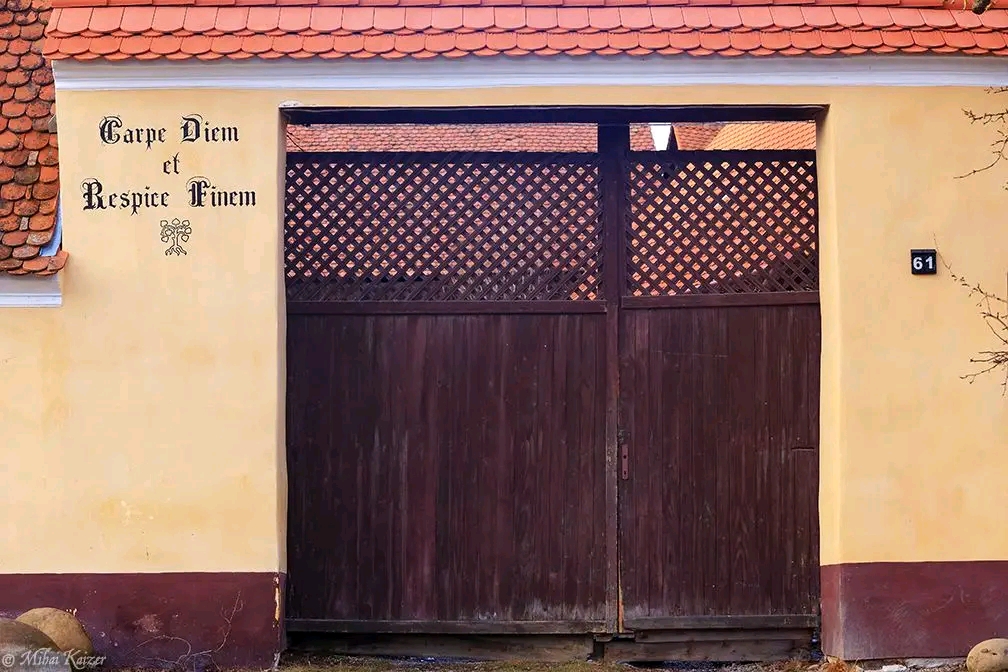
| Carpe Diem et Respice Finem | Viscri (Brașov, România) |
© Mihai Kaizer
| Words written on a gate of a house built in Viscri (Brașov, Transylvania, România) by Michael Fernolend in 1840 and renovated in 2014 by Dietmar Gross, as an incription on the facade says. The words represent two different sayings taken from different (con)texts: the well-known „Carpe Diem” taken from the Roman poet Horace’s work „Odes” I, 11, 8 (23 BC): „Carpe diem, quam minimum credula postero” (~ „Seize the day and trust, as little as you may, in tomorrow”) and „Respice finem” that apparently appears in the 103th chapter of „Gesta Romanorum” [a collection of anecdotes and tales, compiled in Latin, probably by a priest – at the end of
13th century, beginning of 14th century, first two editions published around 1440 and the third edition, probably based directly on Harleian manuscript 5369 (British Museum), was published by Wynkyn de Worde in 1524. The collection became so popular throughout Western Europe that copies were multiplied, often with local additions, so that now it isn’t possible to determine whether it was originally written in England, Germany, or France.]: „Quidquid agas, prudenter agas, et respice finem” [~ „Whatever you do, do cautiously, and look to the end ((/consider that everything has an end or/and consider the end result of your action))”].||
RO
|| Cuvinte scrise pe poarta unei case construite în Viscri (Brașov, Transilvania, România) de Michael Fernolend în 1840 și renovată în 2014 de Dietmar Gross, așa cum spune o inscripție de pe fațadă. Cuvintele reprezintă două expresii luate din două (con)texte diferite: bine-
cunoscutul ”Carpe Diem” ce apare în opera poetului roman Horațiu ”Ode” I, 11, 8 (23 Î.Hr): „Carpe diem, quam minimum credula postero” [~ „Trăiește clipa și încrede-te cât se poate de puțin în ziua de mâine”] și ”Respice Finem” ce apare în capitolul 103 din ”Gesta Romanorum” [o culegere de anecdote și povestiri, scrise în limba latină, cel mai probabil de către un preot către sfârșitul secolului al XIII-lea, începutul secolului al XIV-lea, primele două ediții apărând în jurul anului 1440 și cea de-a treia, bazată cel mai probabil pe manuscrisul Harleian 5369 (aflat în Colecția British Museum), fiind publicată de Wynkyn de Worde in 1524. Colecția a devenit atât de populară în Europa Occidentală încât s-au răspândit multe copii, adesea cu adăugiri locale, încât acum este imposibil de determinat dacă aceasta a fost scrisă prima dată în Anglia, Germania sau Franța]: ”Quidquid agas, prudenter agas, et respice finem” [~ ”Orice ai face, trebuie să faci acest lucru cu precauție, privind către sfârșit (/considerând că totul are un sfârșit sau/și luând în considerare consecințele acțiunilor tale)”].|

