
What’s a conspiracy theory you actually find believable?
I once watched a documentary on the Discovery Channel that explored the promising beginnings of General Motors’ electric cars and the suspicious way in which they were withdrawn from the market, leaving vehicles with fossil-fuel-powered internal combustion engines without competition. Personally, I believe this is a plausible “conspiracy” theory, since the oil mafia and its powerful lobbying networks were able to pressure policymakers to prevent their businesses from being undermined. This is all the more interesting given that electric cars also held the upper hand at the beginning of the 20th century, only to be sidelined later by the interests of companies such as Ford and Daimler-Benz. Although I am not a fan of the way political pressure is being exerted today to promote the widespread adoption of electric vehicles, I believe they emerged organically over the course of the last century, but their evolution was strangely cut short, at least when it comes to personal automobiles—even though electric vehicles have proven successful in the field of public, mass transportation.
History of the electric vehicles
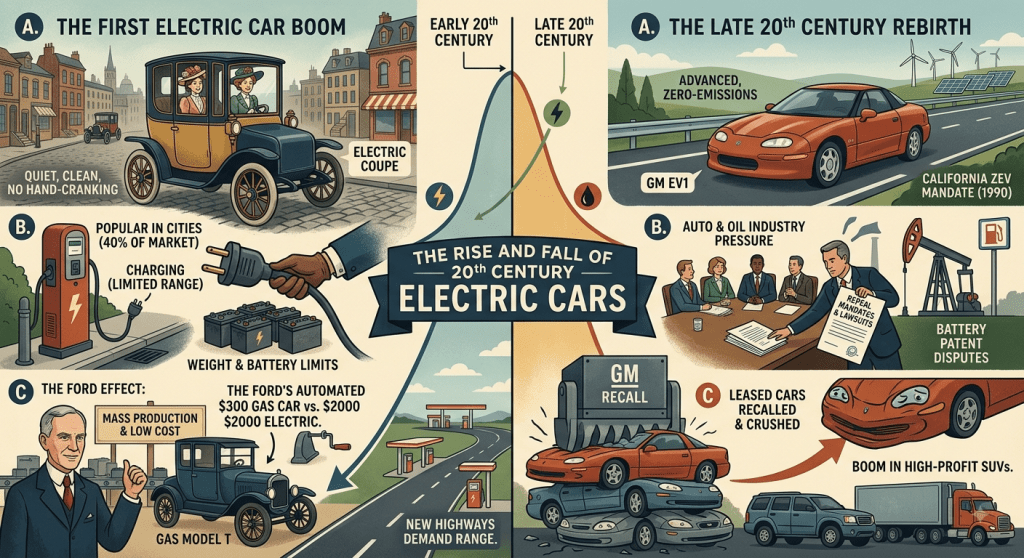
At both the start and the end of the 20th century, electric vehicles (EVs) experienced a booming rise followed by a dramatic decline. Though 80 years apart, both eras ended for surprisingly similar reasons: a mix of technological limitations, market forces, and political maneuvering.
The First Wave: Early 20th Century (1900s–1920s)
At the turn of the 20th century, electric cars weren’t just competitive—they made up nearly 40% of the U.S. automobile market. They were quiet, didn’t emit foul smoke, and didn’t require dangerous hand-cranking to start, making them highly popular for urban driving.
What killed them?
- The Electric Starter (1912): Charles Kettering invented the electric self-starter for gas engines. Gasoline cars suddenly became just as easy to start as electric cars, eliminating their primary advantage.
- Henry Ford & Mass Production: By setting up assembly-line production for the Model T, Ford brought gas car prices down to around $300 by the 1920s. Meanwhile, electric cars remained hand-built luxury items costing over $2,000.
- Road Infrastructure & Oil Discoveries: Massive petroleum discoveries in Texas crashed gas prices. At the same time, states began paving highways between cities. Lead-acid batteries offered only a 30- to 50-mile range and lacked power grid access outside major cities, whereas gas cars could easily drive inter-state.
The Second Wave: Late 20th Century (1990s)
The EV made its return in the 1990s, catalyzed by the California Air Resources Board (CARB) passing the Zero-Emission Vehicle (ZEV) mandate, which forced major automakers to sell electric cars if they wanted to operate in California. This led to GM creating the EV1, alongside response vehicles from Toyota (RAV4 EV), Honda (EV Plus), and Chrysler (EPIC).
What killed them?
- Regulatory Pushback & Lawsuits: Automakers, major oil companies, and the federal government aggressively sued CARB. When CARB softened its mandate under pressure, automakers were no longer legally required to sell or lease EVs.
- Crushing the Fleets: Automakers offered the EV1 and similar vehicles strictly on closed-end leases. Once the mandate was dismantled, companies like GM recalled nearly every vehicle, despite driver protests, and literally crushed them to avoid liability and maintenance costs for a small production run.
- Corporate & Oil Interests: Oil companies lobbied heavily against EV subsidies, and Chevron acquired critical patents on NiMH battery technology, restricting its licensing for large-scale automotive production for years.
- Profitable ICE Alternatives: The late 1990s saw an explosive boom in high-margin gas-guzzling SUVs and trucks, making Detroit automakers reluctant to invest heavily in EVs that offered lower long-term profit margins on replacement parts.
The Common Pattern
In both eras, electric vehicles were constrained by battery energy density relative to cheap fossil fuels. However, while the early 20th-century fall was driven mainly by market economics and engineering breakthroughs in gas cars, the late 20th-century collapse was actively accelerated by policy rollbacks and corporate strategy.
Lithium-Ion batteries determined the electric cars’ resurrection in the 21st century
Lithium-Ion technology was the single biggest technological catalyst for the modern EV resurrection, though it succeeded because it collided with the right consumer tech trends, startup culture, and shifting environmental policies.
Why Lithium-Ion Changed Everything
* Massive Energy Density: Compared to lead-acid and NiMH batteries, lithium-ion provided roughly 2x to 3x the energy density by weight and volume. This allowed cars to carry enough energy for 200+ miles of range without becoming too heavy to drive efficiently.
* The Consumer Electronics Boom: Because laptops and smartphones adopted Li-ion in the 1990s and 2000s, mass production scaled up rapidly. This drove down battery production costs drastically year over year.
* No „Memory Effect”: Older battery chemistries degraded if they were recharged before being fully emptied. Lithium-ion handles partial charging cycles seamlessly, matching real-world driving habits.
The Catalysts That Made It Work
Battery tech alone wasn’t enough; three other factors enabled the comeback:
* The Silicon Valley Proof-of-Concept: Early startups like Tesla realized they didn’t need custom, automotive-grade batteries right away. In 2008, the Tesla Roadster proved the concept by bundling thousands of standard 18650 lithium-ion cells—the exact same batteries used in everyday laptop packs.
* Advanced Computing & Battery Management: Early Li-ion cells were volatile and prone to overheating. Modern microprocessors and complex Battery Management Systems (BMS) made it possible to monitor and cool thousands of individual cells safely in real-time.
* A Change in Target Market Strategy: Early EVs were marketed as small, slow, utilitarian city cars. By using Li-ion batteries, modern automakers flipped the script: they built high-performance, desirable premium vehicles first to absorb the initial high cost of the technology before scaling down to affordable mass-market cars.
This post was made by Gemini A. I. (Except for the introduction)


